Selling Cash-Secured Puts: How They Actually Work
By The Pie , independent options and small-cap research
Published
The Pie is the Nickelpie research desk, not a licensed financial adviser. Nickelpie publishes educational analysis, not personalized investment advice.
Selling a cash-secured put pays you cash today to promise you'll buy 100 shares at a price you choose. If the stock stays above your strike, you keep the cash and walk away. If it falls below, you buy the shares, at a discount, because you keep the premium either way. The catch: if the stock collapses, you still have to buy at your strike. The premium softens that. It does not prevent it.
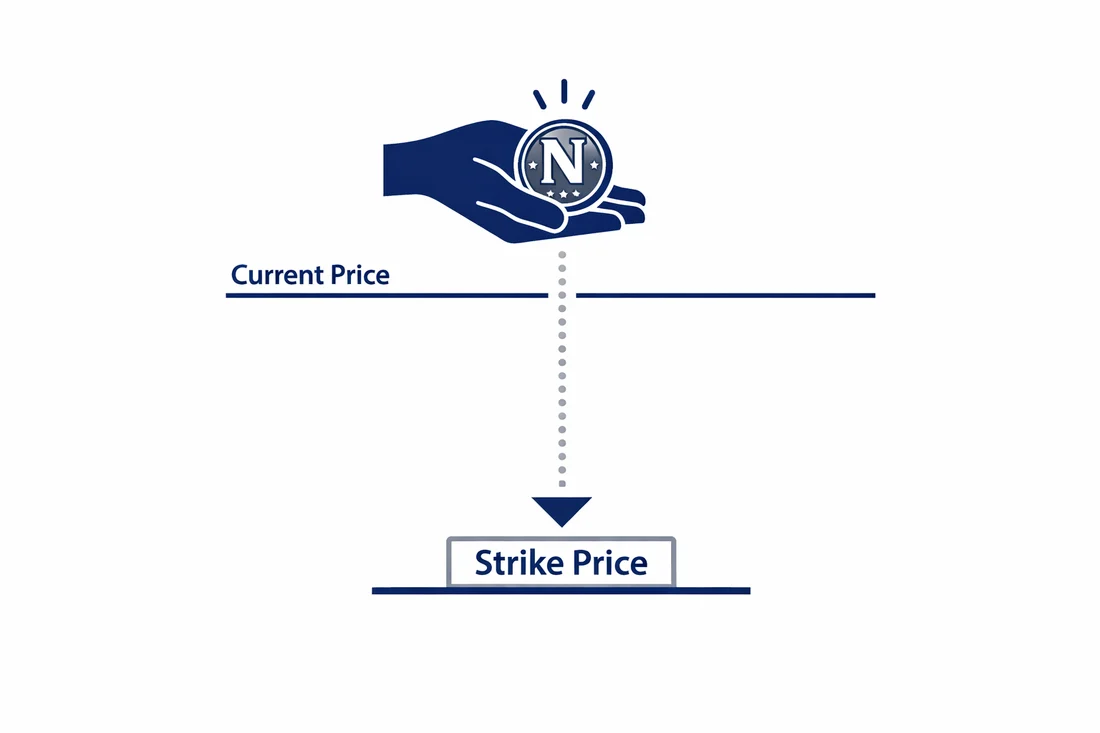
The jacket, and why the analogy matters
Say there's a jacket you want. It costs $50 and you think that's too much, but at $40 you'd buy it happily.
You tell the shop: "If this drops to $40 in the next month, I promise I'll buy it." The shop likes that promise enough to hand you $3 cash today just for making it.
- It drops to $40 → you buy the jacket you wanted, and you already pocketed $3, so it really cost you $37.
- It never drops → you keep the $3 and walk away.
That's a cash-secured put. You get paid to agree to buy something you already wanted, at a price you already liked.
But now finish the story honestly. What if the shop burns down and the jacket is worth $10, and you're still obligated to pay $40? That's the part the analogy usually leaves out, and it's the part that costs people money. A stock can fall much further than you expect, and your promise doesn't expire just because you changed your mind.
The three words you need
| Term | What it means |
|---|---|
| Strike | The price you're promising to buy at (the "$40"). |
| Premium | The cash you're paid for the promise (the "$3"). Yours immediately, always. |
| Expiration | The deadline. After this date, the promise is over. |
| Assignment | The promise came true, you now own 100 shares at the strike. |
A full example, with every outcome
Take a hypothetical stock, XYZ, trading at $22. You'd be happy to own it at $20. You sell one put:
- Strike: $20
- Expiration: 35 days out
- Premium: $0.60 per share = $60 cash, paid to you now
- Cash you must set aside: $20 x 100 = $2,000
Three things can happen. All three are worth understanding before you click sell.
Outcome 1, XYZ stays above $20 (the common case)
The put expires worthless. You keep the $60 and your $2,000 is released. That's 3% on your collateral in 35 days. Do it again.
Outcome 2, XYZ dips to around $20 (the fine case)
You're assigned: you buy 100 shares at $20, paying $2,000. But you were paid $60, so your effective cost is $19.40 a share. You now own a stock you wanted, below the price it was trading at when you started. From here you sell covered calls against it.
Outcome 3, XYZ collapses to $12 (the case nobody shows you)
You are still obligated to buy at $20. You pay $2,000 for shares now worth $1,200. Your $60 premium brings your effective cost to $19.40, so you are down roughly $740 on paper.
Nothing about "the wheel" protects you here. You now own a falling stock, and your options are to hold it, sell covered calls against it at strikes below your cost basis (locking in a loss if assigned), or sell the shares and take the loss. There is no clever escape. This is the risk you were being paid $60 to accept.
This is why "only sell puts on stocks you genuinely want to own" is not a platitude. It is the entire safety mechanism.
Why bigger premium is a warning, not a gift
You will notice some stocks pay dramatically more premium than others. A quiet blue chip might pay 1% for 35 days; a volatile small-cap might pay 12%.
That is not an opportunity. That is the market pricing risk. Premium is high precisely because the market thinks the stock can move violently, and it is usually right about that, on average, over time. Implied volatility is the market's estimate of how far the stock can travel, and the premium is compensation for standing in front of it.
The fatter the premium, the smaller your position should be.
The rules that keep you out of trouble
- Only sell puts on stocks you genuinely want to own at that strike. If you wouldn't buy it there, don't promise to.
- Keep the full cash set aside. Strike x 100. No exceptions while you're learning. This is what "cash-secured" means, and it is what stops a bad trade from becoming a catastrophic one.
- Say your worst case out loud before you sell. "If this went to nearly zero, I'd lose about $____, and I'm okay with that." If you can't finish that sentence honestly, the position is too big.
- Start with one contract. On the cheapest stock you're willing to own. Feel it work end to end before you scale.
Common questions
What is a cash-secured put in simple terms?
You promise to buy 100 shares at a price you choose (the strike) by a date you choose (the expiration). Someone pays you cash today for that promise, the premium, and you keep it no matter what happens next. "Cash-secured" means you set aside the full purchase price: a $20 strike means $2,000 sitting in your account, so you can always honour the promise.
How much money do I need to sell one cash-secured put?
Strike price x 100. A $20 strike needs $2,000. A $5 strike needs $500. This is the hard constraint for a small account, you cannot sell a cash-secured put on a $200 stock without $20,000 set aside, no matter how much you like the company. See how much money you need to start.
What happens if the stock falls below my strike price?
You buy the 100 shares at your strike, even if the stock is far below it. This is the real risk, and most guides skate past it.
Sell a $20 put, collect $60, and the stock falls to $12? You still pay $2,000 for shares now worth $1,200. Your $60 premium softens it, your effective cost is $19.40 a share, so you're down about $740, but it does not prevent it. The premium was never free money. It was payment for taking on a real obligation, and sometimes the obligation costs you.
This is why the first rule exists: only sell puts on stocks you genuinely want to own at that price.
What strike price should I choose when selling a put?
Many sellers target a delta around 0.25 to 0.30. Delta loosely approximates the chance the option finishes in the money, so a 0.25 delta put implies roughly a 75% chance it expires worthless and you simply keep the premium.
But delta is a model output, not a promise. It is derived from current implied volatility, and it updates as the market moves. It is not a guarantee, and treating it as one is how people get hurt.
The more useful rule: pick a strike you would be genuinely happy to own the stock at. Then use delta as a sanity check, not as the decision.
How long until expiration should I sell?
Most premium sellers work in the 21 to 45 day window. The logic is time decay: an option loses value fastest in its final weeks, and collecting that decay is the seller's entire edge. Much shorter and the premium is usually too thin to be worth the obligation. Much longer and your cash is locked up while decay is still crawling.
Is selling a cash-secured put the same as a limit buy order?
Similar, but not the same. Both say "I'll buy lower." The difference: the put pays you to wait, but it obligates you. A limit order can be cancelled for free; a put cannot, you'd have to buy it back, possibly at a loss. And if the stock gaps to $12 overnight, your limit order at $20 would fill near $12, while your $20 put still makes you pay $20.
Keep going
- Selling covered calls, the other half of the wheel
- The wheel strategy, end to end
- How much money do you actually need?
- Which broker should you use?
Before trading options, read the OCC's Characteristics and Risks of Standardized Options. This article is educational analysis, not investment advice.